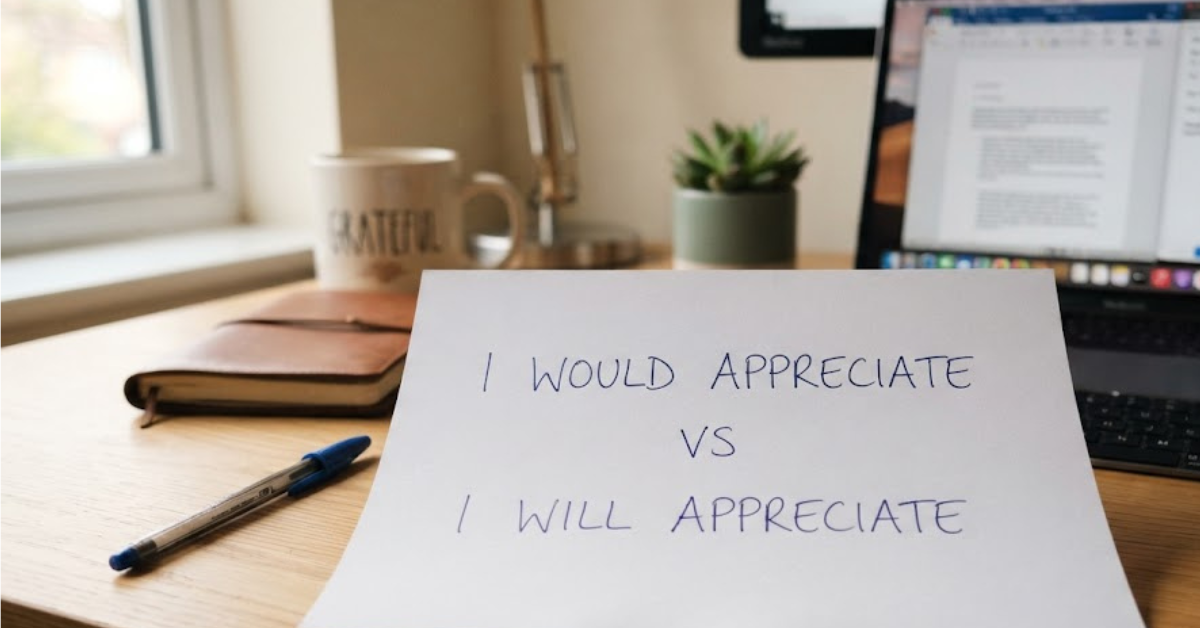
Have you ever written an email and paused before typing, wondering whether you should say “I would appreciate” or “I will appreciate”? You’re not alone. These two phrases look similar, but they aren’t used in the same way, and choosing the wrong one can make your writing sound awkward or unnatural.
If you’ve searched i would appreciate vs i will appreciate, this guide explains the difference in clear, practical terms. You’ll learn when each expression is appropriate, why native English speakers overwhelmingly prefer one over the other, and how to use common variations such as i would greatly appreciate it, i would appreciate your help, and i would really appreciate it in professional and everyday communication.
I Would Appreciate vs I Will Appreciate: The Short Answer
The phrase “I would appreciate” is the standard, polite, and most natural way to make a request in English.
For example:
- I would appreciate your feedback.
- I would appreciate your help.
- I would appreciate it if you could reply by Friday.
By contrast, “I will appreciate” is grammatically correct but much less common. It usually refers to future gratitude after something happens.
For example:
- I will appreciate your support when the project begins.
In most requests, native speakers naturally choose “I would appreciate.”
Why “I Would Appreciate” Sounds More Natural
English often uses the modal verb would to make requests sound polite and less demanding.
Compare these examples:
Less natural:
- I will appreciate your response.
More natural:
- I would appreciate your response.
The second version sounds respectful because it expresses gratitude in advance rather than assuming the other person will help.
This is why you’ll frequently hear it in:
- Business emails
- Customer service messages
- Academic communication
- Professional correspondence
When to Use “I Would Appreciate”
Use this expression whenever you’re politely asking someone to do something.
Common situations include:
- Requesting information
- Asking for assistance
- Seeking clarification
- Requesting feedback
- Asking someone to review your work
Examples
- I would appreciate your help with this report.
- I would appreciate your advice.
- I would appreciate it if you could send the documents today.
- I would appreciate hearing from you soon.
These sentences sound courteous without being overly formal.
When to Use “I Will Appreciate”
Although less common, “I will appreciate” isn’t wrong.
It works when you’re talking about future appreciation rather than making a request.
Examples include:
- I will appreciate any assistance you provide during the transition.
- I will appreciate your patience as we improve our services.
- I will appreciate your continued support in the coming months.
Even in these situations, many native speakers still prefer “would” because it sounds softer and more conversational.
I Would Greatly Appreciate It
The phrase i would greatly appreciate it is a stronger and more formal way to express gratitude in advance.
It adds emphasis without sounding demanding.
Examples:
- I would greatly appreciate it if you could review my application.
- I would greatly appreciate it if you responded before Monday.
- We would greatly appreciate your cooperation.
This phrase is especially common in:
- Business emails
- Scholarship applications
- Customer support requests
- Official letters
I Would Appreciate It
One of the most widely used expressions in English is i would appreciate it.
It’s usually followed by a clause explaining what you’re requesting.
Examples:
- I would appreciate it if you could call me tomorrow.
- I would appreciate it if you kept this confidential.
- I would appreciate it if you let me know your decision.
The phrase sounds polite, professional, and natural.
I Would Appreciate Your Help
Another common variation is i would appreciate your help.
People use it when requesting assistance while remaining respectful.
Examples:
- I would appreciate your help with this assignment.
- I would appreciate your help in resolving this issue.
- I would appreciate your help preparing for the meeting.
Because it directly acknowledges the other person’s effort, it often creates a positive impression.
I Would Really Appreciate It
Adding the word really makes the request feel warmer and more personal.
Examples:
- I would really appreciate it if you could explain this again.
- I would really appreciate it if you replied today.
- I would really appreciate your feedback.
Compared with “greatly,” “really” sounds slightly more conversational and is commonly used in everyday emails and messages.
Formal vs Informal Usage
Choosing the right phrase depends partly on your audience.
| Situation | Recommended Expression |
| Business email | I would appreciate… |
| Job application | I would greatly appreciate it… |
| Customer support | I would appreciate your assistance… |
| Friend or family | I’d really appreciate it… |
| Formal letter | I would appreciate your response… |
In nearly every case involving a request, “would” remains the preferred choice.
Common Mistakes to Avoid
Many English learners make similar errors.
Mistake 1: Using “Will” for Every Request
I will appreciate your reply.
I would appreciate your reply.
Mistake 2: Forgetting “It”
I would appreciate if you could help.
I would appreciate it if you could help.
Including “it” creates the standard grammatical structure.
Mistake 3: Sounding Too Direct
Send me the report today.
I would appreciate it if you could send the report today.
The second version sounds significantly more polite.
Better Alternatives to “I Would Appreciate”
Repeating the same phrase in every email can sound repetitive.
Here are some natural alternatives:
- I would be grateful if…
- I’d be thankful if…
- Your assistance would be greatly appreciated.
- I would value your feedback.
- Thank you in advance for your consideration.
- I would welcome your suggestions.
These alternatives help vary your writing while maintaining a professional tone.
Practical Tips for Professional Writing
To make requests more effective:
- Be polite but direct.
- Explain exactly what you need.
- Include a deadline if necessary.
- Thank the reader in advance when appropriate.
- Keep your request concise.
Clear, respectful communication often leads to faster and more positive responses.
Key Takeaways
- I would appreciate is the preferred phrase for polite requests.
- I will appreciate is grammatically correct but much less common.
- “I would appreciate it if…” is one of the most natural request structures in English.
- “I would greatly appreciate it” adds extra formality and emphasis.
- “I would really appreciate it” creates a warmer, conversational tone.
- Using polite language improves professional and personal communication.
Frequently Asked Questions
Is “I would appreciate” or “I will appreciate” correct?
Both are grammatically correct, but they serve different purposes. “I would appreciate” is the standard choice for polite requests, while “I will appreciate” usually refers to gratitude you expect to feel in the future.
Why is “I would appreciate” more common?
Using would makes a request sound softer and more respectful. It’s the wording most native English speakers use in professional and everyday communication.
Is “I would greatly appreciate it” formal?
Yes. This phrase is more formal than “I would really appreciate it” and is commonly used in business emails, official letters, and professional requests.
Can I say “I would appreciate your help”?
Absolutely. I would appreciate your help is a natural, polite way to ask someone for assistance in both professional and personal situations.
Is “I would really appreciate it” polite?
Yes. Adding “really” emphasizes your gratitude while maintaining a friendly, conversational tone. It’s widely used in emails, messages, and everyday conversations.
Should I always use “it” after “I would appreciate”?
When your sentence is followed by if, the standard construction is “I would appreciate it if…” Including “it” makes the sentence grammatically complete and more natural.
Conclusion
Understanding i would appreciate vs i will appreciate can make a noticeable difference in how your English sounds. While both expressions are grammatically correct, I would appreciate is the preferred choice for making polite requests because it sounds respectful, natural, and professional. Whether you’re writing i would appreciate your help, i would appreciate it, i would greatly appreciate it, or i would really appreciate it, these expressions communicate gratitude while maintaining courtesy.
The next time you write an email, submit a request, or ask someone for assistance, choosing the right phrase will help you sound more confident and fluent. Mastering small distinctions like this is an excellent way to improve both your written and spoken English.