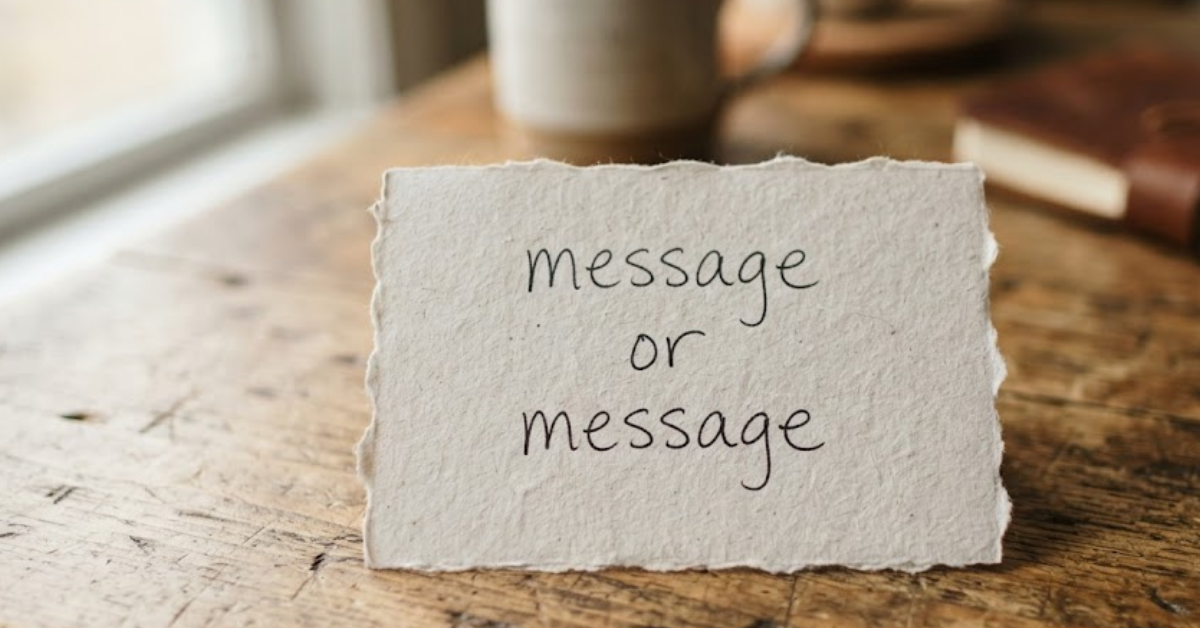
Have you ever paused before sending a text or email because you weren’t sure whether to write “messege” or “message”? You’re not alone. Thousands of people search for messege or message every month because it’s one of the most commonly misspelled words in English.
Fortunately, the answer is straightforward. In this guide, you’ll learn the difference between the two spellings, discover how do you spell message correctly, understand why so many people make the mistake, and pick up simple tricks to remember the correct form every time.
Messege or Message: The Quick Answer
The correct spelling is message.
The word messege is a common misspelling and is not recognized as a standard English word.
Here’s a quick comparison:
| Word | Correct? | Meaning |
| Message | Yes | A piece of communication sent from one person to another |
| Messege | No | Common misspelling of “message” |
Whether you’re writing an email, sending a text, or completing a school assignment, message is always the correct spelling.
What Does “Message” Mean?
A message is any form of communication shared between people. It can be spoken, written, typed, or delivered electronically.
Examples include:
- A text message
- An email message
- A voice message
- A social media direct message
- A handwritten note
- An announcement or important communication
The word can also refer to the central idea or lesson someone wants to communicate.
For example:
“The movie’s message was about kindness and forgiveness.”
How Do You Spell Message?
If you’ve searched how do you spell message, the correct spelling is:
Message
The word contains:
- M
- E
- S
- S
- A
- G
- E
Notice that the middle vowel is “a,” not “e.”
A common mistake is writing:
Messege
Instead of:
Message
Why Do People Spell It “Messege”?
Misspellings happen for several reasons.
1. Pronunciation
In everyday speech, the second vowel sound is subtle, making it easy to confuse “a” and “e.”
2. Typing Quickly
Fast typing often leads to accidental letter substitutions, especially on smartphones.
3. Phonetic Guessing
Many English learners spell words the way they sound. Since “message” isn’t entirely phonetic, people often guess incorrectly.
4. Habit
If you’ve seen friends or classmates write “messege,” it’s easy to assume it’s acceptable—even though it isn’t.
Message vs Messege: Understanding the Difference
The comparison message vs messege is actually quite simple.
Only one spelling exists in standard English.
| Feature | Message | Messege |
| Found in dictionaries | Yes | No |
| Correct spelling | Yes | No |
| Appropriate for school and work | Yes | No |
| Used in professional writing | Yes | No |
If you’re ever uncertain, remember that message is the only correct spelling.
Common Types of Messages
The word appears in many everyday situations.
Text Messages
Short written conversations sent through mobile phones or messaging apps.
Example:
“I’ll send you a message when I arrive.”
Email Messages
Digital communication exchanged through email services.
Example:
“She replied to my message within an hour.”
Voice Messages
Recorded audio that someone can listen to later.
Example:
“Please leave a message after the tone.”
Social Media Messages
Private conversations on platforms like Instagram, Facebook, LinkedIn, or X.
Example:
“I received your message on Instagram.”
Broadcast Messages
Announcements shared with large groups of people.
Example:
“The company sent an important message to all employees.”
The Origin of the Word “Message”
The English word “message” comes from the Old French word message, which referred to a communication sent by a messenger.
Its roots go back even further to Medieval Latin, where similar words described the act of sending news or information.
Although communication methods have evolved—from handwritten letters to instant messaging—the meaning has remained remarkably consistent.
Common Mistakes to Avoid
Here are some examples of incorrect and correct usage.
I sent you a messege.
I sent you a message.
Check your messeges.
Check your messages.
Thanks for the quick messege.
Thanks for the quick message.
Please read my messege carefully.
Please read my message carefully.
These small corrections can make your writing look much more polished.
Tips for Remembering the Correct Spelling
If you often confuse the spelling, these tricks can help.
- Remember that message contains the word “age” at the end.
- Think of the phrase: “Every message gets an A.”
- Read books and articles where the word appears correctly.
- Enable spell-check on your phone or computer.
- Practice writing the word a few times until it becomes familiar.
The more you see the correct spelling, the easier it becomes to remember.
Why Correct Spelling Matters
Using the correct spelling isn’t just about grammar.
It also helps you:
- Communicate clearly
- Make a professional impression
- Avoid misunderstandings
- Improve academic writing
- Build credibility in emails and business communication
Even a simple spelling mistake can distract readers from your message.
Key Takeaways
- Message is the only correct English spelling.
- Messege is a common spelling mistake.
- The word refers to spoken, written, or digital communication.
- Learning the correct spelling improves both personal and professional writing.
- Simple memory tricks can help prevent future mistakes.
Frequently Asked Questions
Is it message or messege?
The correct spelling is message. “Messege” is a common misspelling and should be avoided in formal and informal writing.
Why do people spell message as messege?
Many people rely on pronunciation when spelling. Because the middle vowel sound is subtle, it’s easy to mistakenly use an “e” instead of an “a.”
How do you spell message correctly?
The correct spelling is M-E-S-S-A-G-E. Remember that the word contains an “a” after the double “s.”
Is messege a real English word?
No. “Messege” does not appear as a standard English word in major dictionaries. It is simply a spelling mistake.
How can I remember the correct spelling?
A helpful trick is to remember that every message has an “A” in the middle. Regular reading and writing also reinforce the correct spelling.
Does spell-check always catch “messege”?
Most modern spell-check tools identify “messege” as an error and suggest “message.” However, it’s still useful to learn the correct spelling yourself.
Conclusion
The confusion between messege or message is understandable, but the correct answer is clear: message is the only accepted spelling in standard English. Whether you’re sending a text, writing an email, or preparing a report, using the correct spelling makes your communication more accurate and professional.
The next time you hesitate, remember that message includes an “a” after the double “s.” With a little practice and the memory tips in this guide, you’ll never have to second-guess the spelling again. Strong writing starts with small details, and mastering common words like this is an easy way to improve your confidence and communication skills.