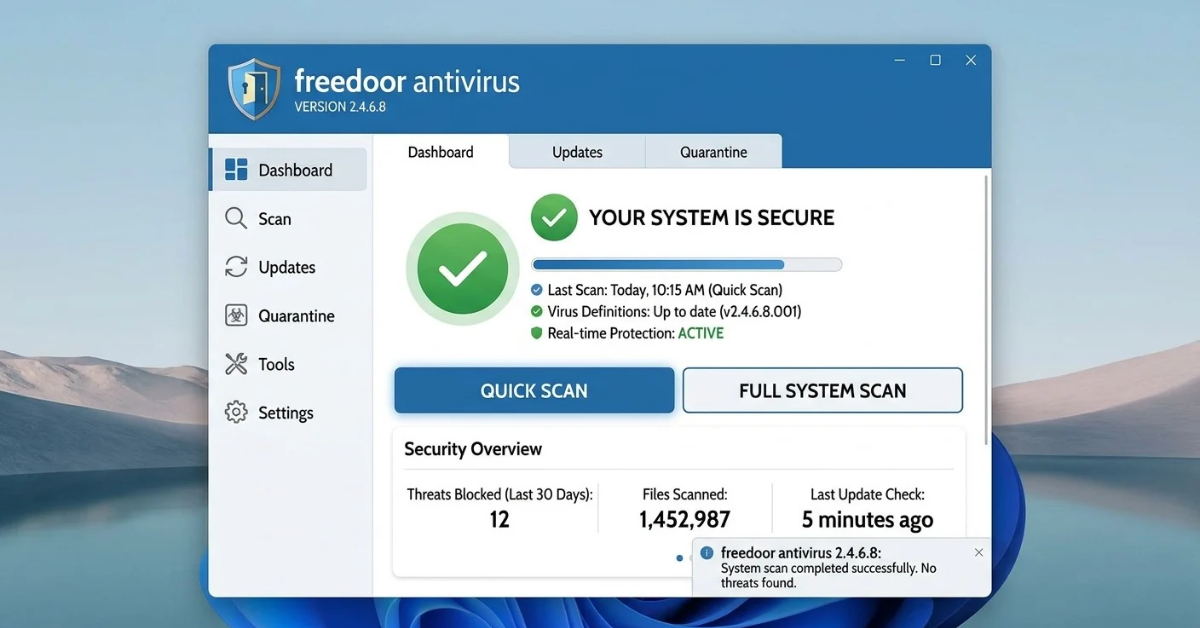
With new cybersecurity threats appearing every day, having reliable antivirus protection has become more important than ever. Whether you’re browsing the internet, downloading files, installing applications, or managing sensitive information, your device needs protection against malware and other online threats.
One term that may attract attention in antivirus-related searches is antivirus freedoor2.4.6.8. However, before downloading or installing software with this name, it’s important to understand what it refers to, whether it is a legitimate security product, and what precautions you should take.
In this guide, we’ll examine the available information, discuss potential security concerns, explain how to evaluate unfamiliar antivirus software, and explore safer alternatives for protecting your computer.
What Is Antivirus Freedoor2.4.6.8?
The first thing to understand is that the identity of this software is not clearly established. Searches for the exact name produce several third-party articles, but they do not provide consistent information about its developer, purpose, official release history, or security capabilities.
Some websites describe it as an antivirus application, while others associate FreeDoor2.4.6.8 with proxy services, network access, or internet privacy tools.
This distinction matters because antivirus software and proxy software serve very different purposes.
-
Antivirus software: Detects, blocks, and removes malicious programs such as viruses, spyware, ransomware, and trojans.
-
Proxy software: Routes internet traffic through another server, potentially changing the visible IP address.
-
Privacy tools: Help manage online tracking, browsing privacy, and network activity.
At present, there is insufficient authoritative documentation to establish which category the exact version belongs to.
Is FreeDoor2.4.6.8 a Real Antivirus Program?
There is no independently verified evidence establishing FreeDoor2.4.6.8 as a recognized antivirus product. In particular, its exact version has not been connected to a clearly identifiable security vendor, verified product documentation, or recognized independent antivirus testing.
This does not prove that every file carrying the name is malicious. However, it means users should not assume that the application provides genuine malware protection.
A legitimate antivirus product should normally provide:
-
An identifiable software developer or company.
-
An official website and verified download location.
-
Product documentation and release information.
-
A transparent privacy policy.
-
Information about supported operating systems.
-
Independent security testing or credible technical reviews.
-
A way to contact customer support.
If these details are missing, it is better to investigate before downloading anything.
Antivirus Freedoor2.4.6.8 Features: What Can Be Verified?
When researching unfamiliar security software, it is important to separate advertised features from technically verified capabilities.
Some online descriptions associate this name with malware scanning, internet protection, network privacy, and system security. However, these claims should not be treated as confirmed product features.
Here is what users should look for when evaluating any application advertised under this name.
1. Malware and Virus Detection
A genuine antivirus application should identify potentially harmful files, including:
-
Computer viruses.
-
Trojan horses.
-
Spyware.
-
Ransomware.
-
Malicious scripts.
-
Potentially unwanted applications.
However, there are no verified independent detection results establishing that FreeDoor2.4.6.8 can perform these functions.
2. Real-Time Protection
Real-time protection continuously monitors files, applications, and other system activities.
A properly developed security solution can help identify suspicious behavior before malware causes significant damage.
Before trusting an unfamiliar application, check whether it provides documented real-time monitoring rather than simply displaying a security dashboard.
3. Internet and Network Protection
Some third-party descriptions associate FreeDoor with network-related functionality.
Network protection and antivirus protection are not interchangeable. A proxy may route traffic through another server, but that alone does not prevent malicious downloads, phishing attacks, or ransomware infections.
4. Privacy and Data Protection
Privacy features can help users manage their online activity and reduce exposure to certain tracking techniques.
Nevertheless, users should carefully review an application’s privacy policy before allowing it to handle internet traffic or access personal information.
5. Automatic Updates
Security software needs regular updates because new malware variants appear continuously.
A trustworthy antivirus provider should explain:
-
How security definitions are updated.
-
How frequently updates are released.
-
Whether updates happen automatically.
-
How vulnerabilities in the application are addressed.
No verified update history has been established for this particular version.
Is Antivirus Freedoor2.4.6.8 Safe to Download?
There is not enough reliable evidence to recommend downloading or installing this software.
One of the biggest mistakes computer users make is assuming that a program is safe simply because a website describes it as an antivirus tool. A convincing product name, attractive interface, or version number does not establish that an application is legitimate.
Before opening an unfamiliar executable, consider these precautions:
-
Check the publisher: Look for a verifiable company name and official website.
-
Inspect the digital signature: Open the file properties and check its digital signature, if available.
-
Scan the download: Use Microsoft Defender or another reputable security scanner.
-
Check the file reputation: Submit the file or its SHA-256 hash to VirusTotal.
-
Avoid suspicious permissions: Be cautious if the program requests unnecessary administrator privileges.
-
Keep existing protection enabled: Never disable your antivirus just to force an unknown application to install.
Remember that even a clean scan does not guarantee that a file is completely safe. New or modified threats may not yet be detected.
How to Check an Unknown Antivirus Download on Windows
If you have already downloaded a file labelled FreeDoor2.4.6.8, you can perform several checks before deciding what to do with it.
Step 1: Check the File Properties
Locate the downloaded file and follow these steps:
-
Right-click the file.
-
Select Properties.
-
Check the General tab for file information.
-
Look for a Digital Signatures tab.
-
Examine the publisher details if a signature exists.
An unsigned file is not automatically malicious, but an unknown publisher deserves additional scrutiny.
Step 2: Scan the File With Microsoft Defender
Microsoft Defender is built into modern Windows versions and provides antivirus and threat-protection features.
To scan a downloaded file:
-
Locate the file in File Explorer.
-
Right-click it.
-
Select Scan with Microsoft Defender (the exact menu wording may vary).
-
Allow the scan to finish.
-
Review the results before taking further action.
Do not run the file if Windows identifies it as a threat.
Step 3: Check the File With VirusTotal
VirusTotal is a useful resource for checking suspicious files against multiple security engines.
Visit VirusTotal’s official website and:
-
Select the file upload option.
-
Upload the downloaded executable if appropriate.
-
Wait for the analysis to complete.
-
Review the detection results.
-
Investigate any security warnings.
Privacy note: Uploaded files may be shared with security partners and researchers. Do not upload confidential documents, private business files, or sensitive personal information.
What Should You Do If You Have Already Installed It?
If you have installed an unfamiliar application carrying this name, there is no need to panic. However, it is worth checking your computer for unwanted software or suspicious activity.
Follow these steps:
1. Disconnect From the Internet if You Suspect an Infection
If the application is behaving suspiciously, disconnect your computer from Wi-Fi or Ethernet. This can help limit communication with potentially malicious servers while you investigate.
2. Uninstall the Unverified Application
On Windows 10 or Windows 11:
-
Open Settings.
-
Select Apps.
-
Open Installed Apps or Apps & Features.
-
Find the unfamiliar application.
-
Select Uninstall if you do not recognize or trust it.
Do not remove legitimate Windows components simply because their names look unfamiliar.
3. Run a Full Antivirus Scan
Open Windows Security and navigate to:
Virus & threat protection → Scan options → Full scan.
A full scan checks your device more thoroughly than a quick scan. If you continue experiencing suspicious activity, consider Microsoft Defender Offline, which can scan your computer after restarting.
Microsoft Support+1
4. Check Browser Extensions and Notifications
Some unwanted applications and misleading websites can interfere with browser settings.
Review:
-
Recently installed Chrome or Edge extensions.
-
Websites permitted to send notifications.
-
Unfamiliar search engines.
-
Unexpected homepage changes.
-
Suspicious browser redirects.
Remove anything you cannot identify or trust.
5. Change Important Passwords
If you suspect that your device or accounts have been compromised, change important passwords using a separate, trusted device.
Prioritize:
-
Email accounts.
-
Banking and financial accounts.
-
Social media profiles.
-
Business accounts.
-
Cloud storage services.
Enable two-factor authentication wherever possible.
Best Antivirus Alternatives to Consider
If your main objective is protecting your computer against viruses, ransomware, spyware, and other malware, choosing a recognized security provider is a better option than relying on an unverified application.
Here are some established alternatives.
1. Microsoft Defender
A practical starting point for Windows users. It provides real-time malware protection, scanning, and integration with Windows Security.
2. Bitdefender
Offers antivirus products with malware detection, web protection, and additional security features depending on the subscription.
3. Malwarebytes
Known for malware scanning and protection against various unwanted and malicious applications. Its available features depend on the selected plan.
4. ESET
Provides security solutions for home users and businesses, including malware detection and additional network security features.
5. Norton
Offers antivirus and broader online security products, with features varying by subscription and device.
Which Antivirus Should You Choose?
The right choice depends on your device, budget, and security requirements.
| Your requirement | Suggested option |
|---|---|
| Basic Windows protection | Microsoft Defender |
| Additional malware protection | Malwarebytes |
| Comprehensive home security | Bitdefender |
| Home and business security | ESET |
| Broader online protection | Norton |
Before purchasing any subscription, compare its current features, device limits, renewal prices, and independent test results.
FreeDoor vs. Freegate: Are They the Same?
Another source of confusion is the similarity between the names FreeDoor and Freegate.
Freegate is a documented anti-censorship application developed by Dynamic Internet Technology. Its purpose is to help users access internet content through its network service.
However, that does not establish that FreeDoor2.4.6.8 is an official Freegate release or that both names refer to the same application.
This distinction is important:
-
Freegate is documented as a network-access and anti-censorship tool.
-
An antivirus application is designed to identify and protect against malware.
-
The exact identity and purpose of the FreeDoor version discussed here remain unverified.
If you are looking for Freegate, consult its developer’s official website rather than downloading a similarly named executable from an unknown source.
Common Mistakes to Avoid When Downloading Antivirus Software
Even experienced computer users can make mistakes when choosing security applications. Here are some common problems worth avoiding.
-
Trusting unknown download websites: A download page is not proof of authenticity.
-
Ignoring security warnings: Never dismiss a malware warning without investigating it.
-
Disabling existing antivirus protection: This can leave your device exposed.
-
Installing multiple antivirus applications: Running several real-time antivirus products simultaneously can create conflicts.
-
Ignoring software updates: Outdated applications may contain security vulnerabilities.
-
Sharing sensitive information: Avoid giving unknown software access to passwords, banking information, or personal files.
A cautious approach is especially important when an application has no clearly identifiable developer or verified release history.
Frequently Asked Questions (FAQs)
1. What is antivirus freedoor2.4.6.8?
It is a software-related search term appearing on various websites. Some describe it as an antivirus program, while others associate it with networking and proxy functionality. Its exact identity has not been independently verified.
2. Is FreeDoor2.4.6.8 a legitimate antivirus?
There is insufficient evidence to confirm that it is a legitimate antivirus product. No verified security vendor or independent testing record has been established for this exact version.
3. Is it safe to download FreeDoor2.4.6.8?
It is not recommended to download it from unknown websites. First verify the developer, official download source, digital signature, and security reputation of the specific file.
4. Does FreeDoor2.4.6.8 protect against malware?
There are no independently verified test results demonstrating its malware detection capabilities. Users should rely on established antivirus solutions for protection.
5. Can I use it on Windows 10 and Windows 11?
Its official Windows compatibility has not been established. Do not assume that a third-party download will work correctly on either operating system.
6. Is FreeDoor2.4.6.8 free?
Its official pricing and licensing information could not be verified. Be cautious of websites requesting payment or personal information for an application without an identifiable publisher.
7. What should I use instead of FreeDoor2.4.6.8?
Microsoft Defender is a sensible starting point for Windows users. Other established alternatives include Bitdefender, Malwarebytes, ESET, and Norton.
8. How can I check whether a downloaded antivirus file contains malware?
You can scan the file using Microsoft Defender and check its reputation through VirusTotal. You should also inspect its digital signature and download source before opening it.
9. Is FreeDoor2.4.6.8 the same as Freegate?
There is no verified evidence establishing that they are the same application. Freegate is a documented network-access tool, not a substitute for antivirus protection.
10. What should I do if Windows blocks the application?
Do not immediately bypass the warning. Investigate the detection, verify the publisher, and scan the file. If its authenticity cannot be established, delete the download.
Conclusion
Searching for antivirus freedoor2.4.6.8 can lead to confusing information, particularly because different websites describe the software in different ways. Some associate it with antivirus protection, while others discuss networking and internet privacy.
The most important takeaway is that its identity, developer, and security capabilities have not been independently verified. Therefore, downloading or relying on it for computer protection is not advisable without further evidence.
If your priority is keeping your computer safe, consider using Microsoft Defender or another established antivirus solution. Always download security applications from official websites, keep your operating system updated, and investigate unfamiliar programs before installing them.
Ultimately, good cybersecurity starts with informed decisions. Taking a few minutes to verify software can help protect your personal information, important files, and overall digital security.